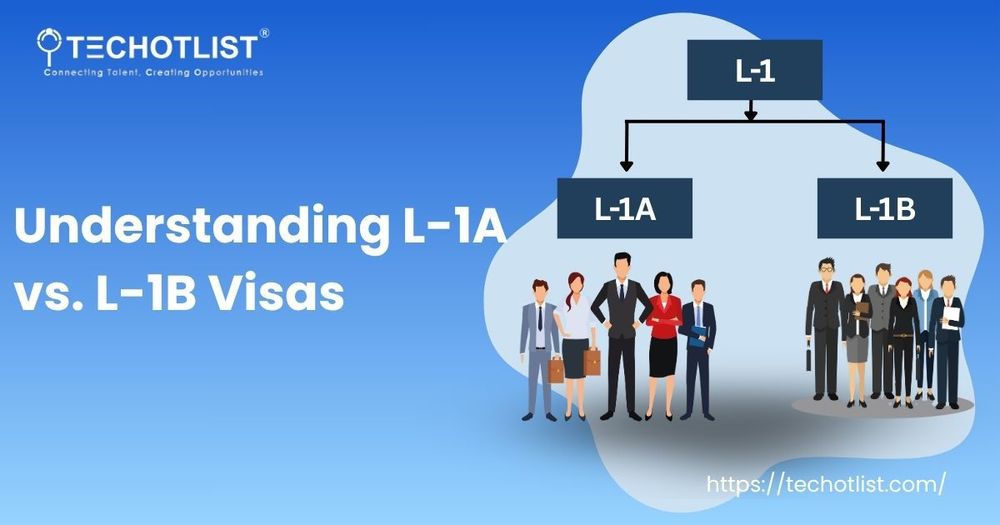
L1A vs L1B Visa Key Differences Eligibility and Green Card Path 2026 Guide
Introduction
The L1A vs L1B visa comparison is essential for professionals planning an intracompany transfer to the United States in 2026. With evolving USCIS L1 visa rules, choosing the right visa category can directly impact your career growth, salary potential, and long term immigration goals.
This guide explains the difference between L1A and L1B visa, including eligibility, duration, salary expectations, and green card options.
TLDR L1A vs L1B Visa 2026
The L1A vs L1B visa difference depends on your job role and long term goals.
L1A visa is for managers and executives and offers a faster green card pathway through EB1C without PERM. It allows a stay of up to 7 years and is ideal for leadership roles.
L1B visa is for employees with specialized knowledge and requires PERM for a green card. It allows a stay of up to 5 years and is suited for technical professionals.
In 2026, L1A visa is generally better due to easier approvals and faster permanent residency options, while L1B visa faces higher scrutiny and denial rates.
What is an L1 Visa and Who Qualifies for Intracompany Transfer
The L1 visa USA intracompany transfer program allows multinational companies to move employees from a foreign office to a US branch. This intracompany transferee visa USA supports global business expansion.
Basic eligibility
At least one year of work experience with the company abroad within the last three years
Transfer to a related US entity such as a parent company subsidiary or affiliate
Role must qualify under L1A or L1B category
L1A vs L1B Visa Quick Comparison 2026
| Feature | L1A Visa | L1B Visa |
|---|---|---|
| Role | Managers and Executives | Specialized Knowledge Employees |
| Stay Duration | Up to 7 years | Up to 5 years |
| Green Card Path | EB1C no PERM required | EB2 or EB3 with PERM required |
| Approval Difficulty | Moderate | Higher scrutiny |
| Career Growth | Leadership roles | Technical roles |
L1A Visa Requirements Benefits and Green Card Path
The L1A visa is designed for managers and executives responsible for leading teams or departments.
L1A visa requirements
Managerial or executive role
Authority in decision making
Supervision of employees or key business functions
Benefits of L1A visa
Direct EB1C green card pathway
No PERM labor certification required
Stay duration up to 7 years
Strong option for long term settlement
The L1A visa is widely preferred for professionals seeking permanent residency in the United States.
L1B Visa Requirements Specialized Knowledge and Challenges
The L1B visa is intended for employees with specialized knowledge about company products systems or processes.
L1B visa requirements
Advanced technical or proprietary knowledge
Deep understanding of company operations
Skills that are difficult to replace
Key challenges
Stricter evaluation under USCIS L1 visa rules 2026
Strong documentation required
Increasing L1 visa denial rate for weak applications
The L1B visa is more complex due to higher scrutiny compared to L1A.
L1A vs L1B Visa Key Differences in Role Duration and Green Card
Job role difference
L1A visa focuses on leadership roles including managers and executives
L1B visa focuses on technical expertise and specialized knowledge
Duration and extensions
L1A duration up to 7 years
L1B duration up to 5 years
Green card process
L1A visa
Eligible for EB1C green card
No PERM process required
Faster processing
L1B visa
Requires PERM labor certification
Longer processing time
Dependent on employer sponsorship
This highlights the major difference in L1A vs L1B green card options.
Salary expectations 2026
L1A salary is generally higher due to managerial responsibilities
L1B salary is competitive for technical roles
Which is Better L1A or L1B Visa in 2026
Choosing between L1A vs L1B visa depends on your career goals.
Choose L1A if
You are in a managerial or executive role
You want a faster green card pathway
You plan long term settlement in the US
Choose L1B if
You have strong technical or specialized skills
Your role is not managerial
You are moving for project based work
For long term benefits the L1A visa is generally the better option.
Latest USCIS L1 Visa Rules 2026 and Approval Trends
Stricter evaluation under USCIS L1 visa rules 2026
Higher documentation requirements
Increased scrutiny for specialized knowledge roles
Slight increase in L1 visa denial rate
Applicants must clearly define job roles and provide strong supporting evidence.
Common Mistakes That Lead to L1 Visa Rejection
Choosing the wrong visa category
Weak job role explanation
Incomplete documentation
Mismatch between job role and visa eligibility
Avoiding these mistakes can significantly improve approval chances.
FAQs
Which is better L1A or L1B for green card
The L1A visa is better for a green card because it qualifies for the EB1C category, which does not require PERM labor certification. This makes the process faster and simpler compared to the L1B visa, which typically requires PERM under EB2 or EB3.
Is L1A to green card faster
Yes, the L1A to green card process is faster because it uses the EB1C category, which skips the PERM process. This reduces processing time and makes it one of the quickest employment based green card pathways.
Are L1A and L1B the same type of visa
Yes, both L1A and L1B visas are part of the L1 intracompany transferee visa category. However, they differ in eligibility. L1A is for managers and executives, while L1B is for employees with specialized knowledge.
Are Indians eligible for a L1 visa
Yes, Indian professionals are eligible for the L1 visa if they meet the requirements. They must work for a multinational company with offices in both India and the United States and have at least one year of experience with the company abroad within the last three years.
Conclusion
The L1A vs L1B visa decision plays a critical role in shaping your career in the United States. While the L1B visa is suitable for specialized professionals, the L1A visa offers better opportunities for leadership roles, higher salary potential, and faster green card processing.
With evolving USCIS L1 visa rules 2026, selecting the correct visa category and preparing a strong application is essential for long term success.