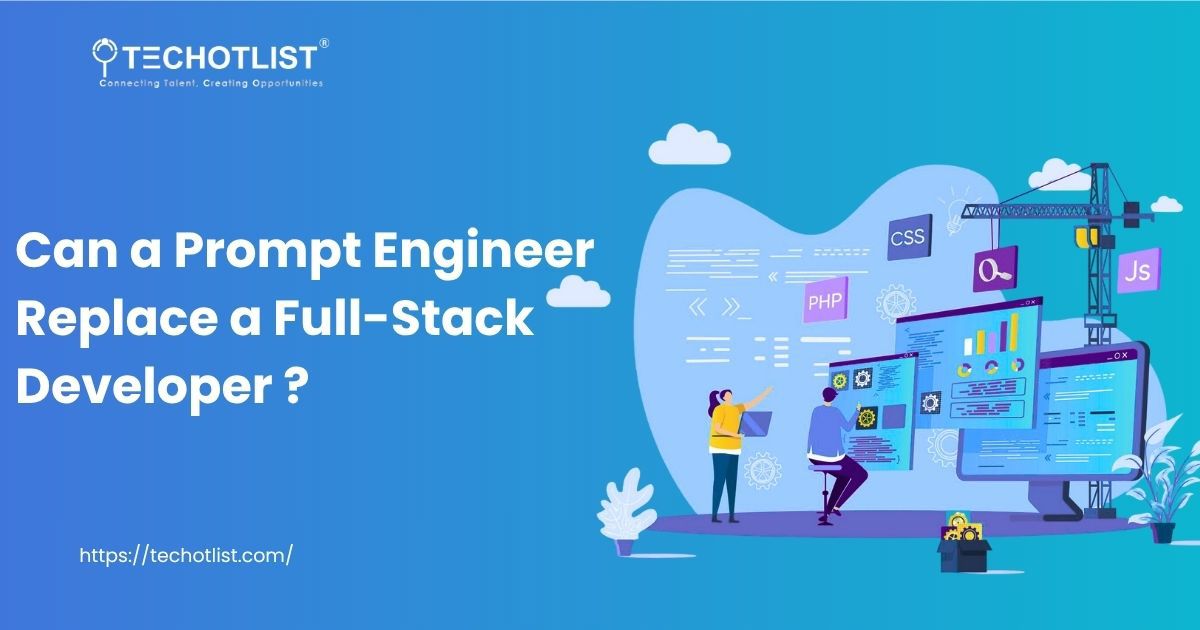
Prompt Engineer vs. Full-Stack Developer: Orchestrating the 2026 AI-Native Lifecycle
Prompt Engineer vs. Full-Stack Developer: Orchestrating the 2026 AI-Native Lifecycle
TL;DR: Prompt engineering is transitioning from a standalone "hack" to a core Software Engineering Entity. In 2026, the market value lies in AI-Orchestration. Full-stack developers are not being replaced; they are evolving into System Architects who use High-Context Prompting to manage up to 80% of the codebase, focusing human effort on Security Auditing and Architectural Integrity.
The provocative question—"Will Prompt Engineers replace Full-Stack Developers?"—is becoming obsolete. In the current landscape, the two roles are merging into a hybrid discipline. However, understanding the Entity Mapping between these roles is vital for any professional looking to secure high-compensation roles in 2026.
As AI models become more "Agentic," the distinction between "writing code" and "prompting code" has blurred, creating a new standard for technical excellence.
Entity Mapping: Redefining the 2026 Skillsets
To rank for modern search queries, we must understand how these roles function within an Agentic Ecosystem. Google no longer looks for the keyword "developer"; it looks for the entity's relationship to the Software Development Lifecycle (SDLC).
- Prompt Engineering Entity: Focuses on Context Window Optimization, Few-Shot Prompting, and Chain-of-Thought (CoT) reasoning. Their primary value is in Latent Space Navigation—knowing exactly how to steer a model to generate specific logic patterns without the model "hallucinating" or drifting off-task.
- Full-Stack Entity: Focuses on State Management, Data Persistence, and Edge Runtime Execution. Their primary value is in System Resilience—ensuring that the AI-generated code survives real-world traffic, handles database migrations correctly, and remains secure against evolving cyber threats.
The "Information Gain" Reality: Why AI Can't "Build" Alone
The 2026 reality check for those relying solely on prompts is the "Contextual Ceiling." Here is the unique insight into why the Full-Stack foundation remains the "Anchor Entity" for any production-grade application:
1. Deterministic vs. Probabilistic Logic
AI is probabilistic—it guesses the next most likely token. Software, however, must be deterministic—it must work exactly the same way every time. A prompt engineer might get a "working" snippet, but a Full-Stack Developer understands how to wrap that snippet in Unit Testing and Integration Audits to ensure it doesn't fail when a user performs an unexpected action.
2. The Architectural Entropy Problem
AI-generated code often suffers from "Entropy." While a model can write a perfect single function, it lacks a long-term "mental map" of an entire 100,000-line codebase. Without a human developer to manage the Dependency Tree and Modular Architecture, prompt-built apps quickly become unmaintainable "spaghetti code."
3. The Security & Sanitization Entity
Prompt-generated code is notorious for including Zero-Day Vulnerabilities or using deprecated libraries that have security holes. A Full-Stack Developer’s value in 2026 lies in their ability to perform AI-Code Sanitization, ensuring that generated snippets don't leak environment variables or ignore CORS policies.
Prompt Engineer vs. Full-Stack Developer: Key Differences
| Aspect | Prompt Engineer (2026) | Full-Stack Developer (2026) |
|---|---|---|
| Primary Skill | Natural Language Logic & Model Tuning | Systems Thinking & Algorithmic Design |
| Tools Used | LangChain, Vector DBs, PromptFoo | React, Next.js, Docker, Kubernetes |
| Deliverables | Reusable Prompt Templates & AI Workflows | Full-stack Production Environments |
| AI Dependency | High — Relying on Model Availability | Strategic — Using AI as a Multiplier |
| Salary Peak | $140K - $160K | $170K - $220K+ (Augmented) |
The Case Study: The "Prompt-Only" MVP Failure
In early 2025, a prominent U.S. startup tried to build an entire Appointment Booking SaaS using only "No-Code Prompting."
The Result: The UI looked perfect, but the backend couldn't handle "Race Conditions" (two people booking the same slot at the same millisecond).
The Fix: A Full-Stack Developer had to step in and implement Database Transactions and Locking Mechanisms—concepts that general prompt engineers often miss because AI models tend to provide the simplest solution rather than the most robust one.
The Future: The AI-Augmented Orchestrator
By 2026, the "Prompt Engineer" and "Full-Stack Developer" are converging into a single entity: the AI-Augmented Orchestrator. Future-forward tech teams no longer hire people to "type code"; they hire people to manage AI agents that type code.
- Prompting handles the "What": Generating boilerplate, writing documentation, and creating initial unit tests.
- Engineering handles the "How": Managing scalability, DevOps, cloud infrastructure, and user experience (UX) refinement.
Frequently Asked Questions (PAA Optimized)
Can prompt engineers replace full-stack developers in 2026?
No. While prompt engineers can prototype at lightning speed, they lack the technical foundation to manage database normalization, server-side rendering (SSR), and cloud infrastructure. The role is moving from "writing code" to "auditing and orchestrating code."
What are the most in-demand skills for a developer in 2026?
The highest Information Gain comes from mastering RAG (Retrieval-Augmented Generation), vector database management, and agentic workflows. Simply "knowing JavaScript" is no longer enough; you must know how to feed JavaScript into an LLM context window effectively using advanced techniques like Retrieval-Augmented Programming.
Is prompt engineering a sustainable career path?
Only if combined with a technical domain. Standalone "prompting" is rapidly being automated by the models themselves. The sustainable path is becoming a Technical Prompt Engineer—someone who understands the underlying code enough to prompt the AI for complex architectural changes and security patches.
Conclusion: The Information Gain Advantage
In 2026, you don't compete with AI; you compete with other professionals who use AI better than you. The "Prompt vs. Developer" debate is over. The winner is the developer who can speak the language of LLMs fluently while maintaining the rigorous standards of a traditional software engineer.
At Techotlist, we prioritize Entity-Based Hiring, connecting you with teams that value the fusion of AI-fluency and architectural depth. We don't just look for coders; we look for the next generation of AI-Native Orchestrators.
Master the 2026 tech shift. Explore AI-Augmented leadership roles at Techotlist.com.
Related posts
Mobile Development Career Paths in the U.S.: iOS vs Android vs Cross-Platform
16 Jul 2025
The Role of UI/UX in U.S. Product Teams: Design Thinking, Jobs, and Visa-Focused Portfolios
10 Jul 2025
AI vs Cybersecurity in 2025: Which Career Path Pays More?
15 Jul 2025
Tech Burnout 2025: Digital Overload Is Crushing Developers & Engineers
15 Jul 2025
Imposter Syndrome in Senior Engineers: Navigating the Hidden Reality of 2026 Tech
03 Apr 2026