Why Good Candidates Still Get Ignored in 2026 (The Brutal Truth About Hiring No One Tells You)
“You don’t get paid for the hour. You get paid for the value you bring to the hour.”, Jim Rohn
Meet two candidates.
Candidate A: 8 years of experience. Top engineering college. Solid project history. Applies to 127 jobs in 3 months. Gets 3 callbacks.
Candidate B: 5 years of experience. Tier-2 college. Similar technical background. Applies to 18 jobs. Gets 11 callbacks.
Same market. Same roles. Wildly different outcomes.
What’s going on?
Welcome to the quiet truth of hiring in 2026: Being good is no longer enough. Being visible + positioned + risk-reducing is the new game.
This article isn’t about what’s unfair. It’s about what’s real, and what you can do about it starting this week.
Why Good Candidates Get Ignored in Today’s Job Market
Because hiring has fundamentally changed, and most job seekers are still playing by 2018 rules.
Here’s the 2026 reality:
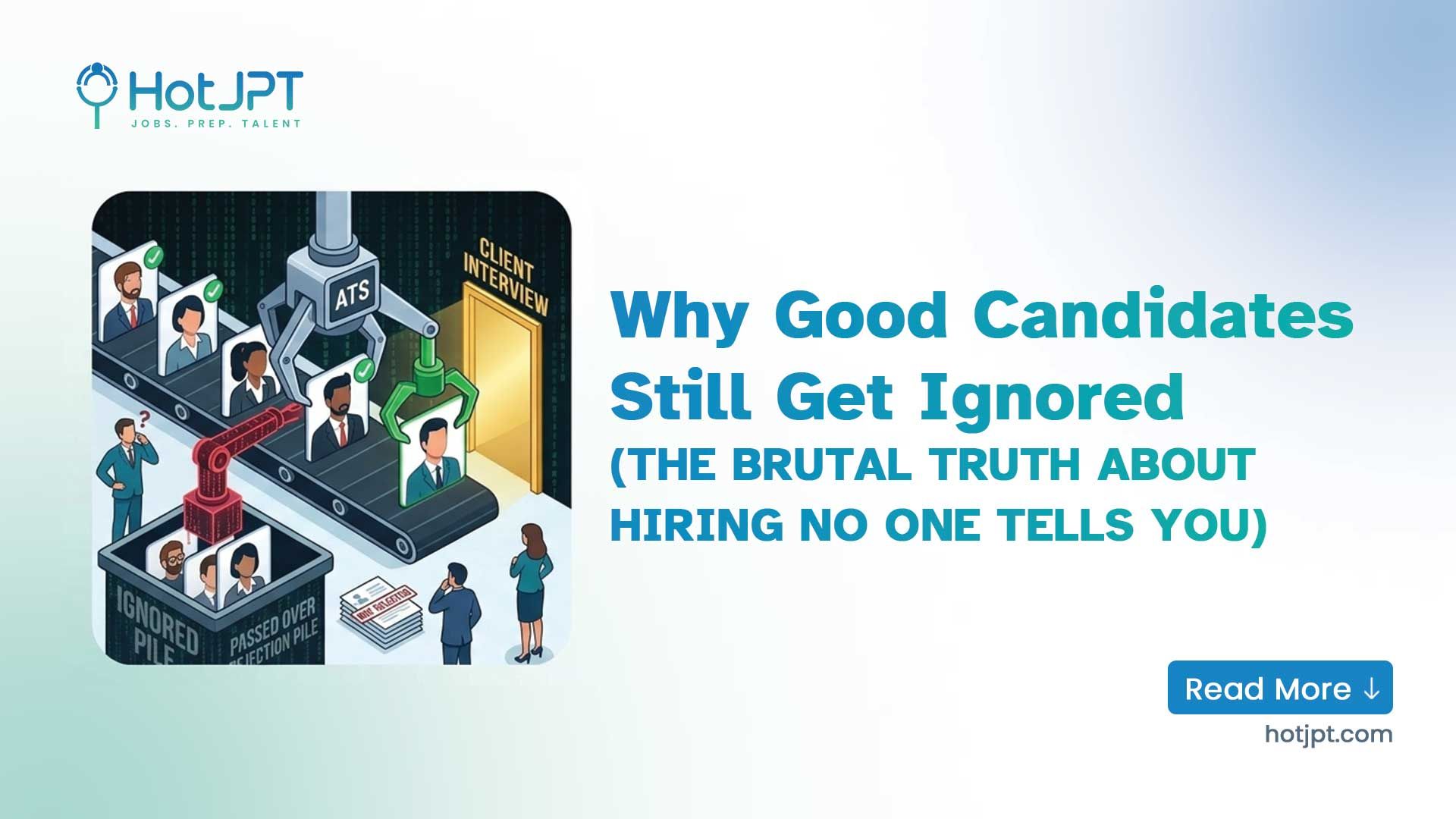
- 75%+ of applications are filtered by AI + ATS in under 10 seconds
- Recruiters see 200+ applications per role within 48 hours of posting
- AI-generated resumes now flood every inbox, making human recruiters more skeptical, not less
- Hiring managers don’t hire the best candidate. They hire the lowest-risk, clearest-fit candidate
Skill is no longer the bottleneck. Signal is.
Seth Godin said it clearly: “You’re not going to out-compete people by copying them. You
have to do something different.”
Most applicants look identical on paper. That’s exactly the problem, and exactly the opportunity.
1. Are resumes being read by AI?
In 2026, the answer is almost always: machine first, human second.
If your resume doesn’t pass the AI + ATS scan, no human ever sees you. Not even for a second.
Machines look for:
- Clear role-aligned keywords (in context, not stuffed)
- Clean structure and standard headings
- Measurable outcomes, not vague claims
- Recent, relevant experience near the top
This is why brilliant candidates with unusual career paths get filtered out while average candidates with “cleaner” profiles get through. Not fair, but fixable.
Rule of 2026: Write for the machine first, charm the human second. In that order.
Also Read: How to Explain Resume Gaps: Reasons, Examples & Interview Tips
2. Does your resume scream “outcomes”, or “responsibilities”?
Most resumes read like a job description copy-pasted. That kills you instantly.
Compare:
- “Responsible for managing the CRM and supporting sales team.”
- “Rebuilt CRM workflows, cut lead response time from 48 hours to 4, contributed to 22% increase in Q3 pipeline.”
Peter Drucker wrote: “What gets measured gets managed.”
In 2026, we add: What gets quantified gets hired.
Numbers, percentages, timeframes, business outcomes, these are the trust signals. Everything else is noise.
3. Do you have a clear “why you” signal?
This is the biggest one, and the most invisible.
Hiring managers aren’t searching for talent. They’re searching for risk reduction.
They’re asking:
- “Can this person do this job from day 1?”
- “Will they fit my team?”
- “Will I look smart for hiring them?”
If your profile doesn’t instantly answer these, even if you’re brilliant, another “safer” candidate wins.
Simon Sinek famously said: “People don’t buy what you do. They buy why you do it.”
Hiring managers don’t hire what you can do. They hire how clearly you position why you’re the lowest-risk, highest-fit choice.
4. Do you have any proof beyond your resume?
In 2026, your resume is Exhibit A. But you also need Exhibit B, C, and D.
- A LinkedIn profile that reads like a case study, not a CV
- A public portfolio, GitHub, Behance, Notion, a personal site, showing real work
- A digital footprint of how you think, posts, comments, writing
- Referrals from people who’ve actually seen you work
Tom Peters said it decades ago and it’s only truer now: “You are the CEO of Me Inc.”
If I Google you after reading your resume, what do I find?
Nothing? Then you’re invisible.
A consistent story across platforms? Then you’re a safe bet.
5. Are you applying, or are you positioning?
Most candidates apply. Very few position.
Applying is sending the same resume to 50 jobs and praying.
Positioning is:
- Reading the JD line-by-line
- Rewriting your top 3 bullets to match the role’s hidden priorities (the ones between the lines)
- Sending a message to the recruiter that says “Here’s why I’m exactly who you’re looking for, in 2 sentences.”
- Having 1 person inside the company already know your name before your resume hits their desk.
Also Read: H-1B FY2027: Selected or Not, Here’s Your Actual Next Move
Dale Carnegie wrote in How to Win Friends and Influence People: “When dealing with people, remember you are not dealing with creatures of logic, but with creatures of emotion.”
Every hiring decision is an emotional decision justified with logic. Positioning is how you earn both.
So what do the invited candidates actually do differently?
After reviewing what actually works in 2026, here’s the pattern from Candidate B (the one with 11 callbacks from 18 applications):
1. They apply less, but better. 18 tailored applications will always beat 127 generic ones. Quality of positioning > quantity of applications.
2. They have a 1-line thesis. “I’m the person who helps B2B SaaS companies turn trial users into paying customers using lifecycle automation.” Boom. Instant clarity. No hiring manager has to guess.
3. They reach out before applying. A short, genuine message to a recruiter or team member on LinkedIn, before submitting, multiplies callback rates 4–8x.
4. They show proof without being asked. A link to a GitHub repo. A Notion case study. A LinkedIn post explaining a hard problem they solved. Proof beats promise.
5. They control the narrative. Their resume, LinkedIn, and intro message all say the same story. No hiring manager has to mentally reconcile who they are.
Naval Ravikant put it well: “Specific knowledge is found by pursuing your genuine curiosity.
It can’t be taught, but it can be captured.”
You already have specific knowledge. The question is have you captured it anywhere the market can see?
The bottom line
Being ignored is not proof that you’re not good enough.
It’s proof that the market hasn’t been shown a clear reason to say yes.
The good news? You don’t need a fancier college, a bigger brand name, or another certification. You need 3 things, and they’re all within your control:
- A clearer story (positioning)
- A cleaner proof (outcomes + portfolio)
- A calmer playbook (targeted applications, not spray-and-pray)
Maya Angelou said: “People will forget what you said, people will forget what you did, but people will never forget how you made them feel.”
Your resume is how you make a recruiter feel in 10 seconds.
Make them feel: “This is the low-risk, high-fit person I’ve been looking for.”
That’s the whole game.
If this made you rethink your job search, forward it to the friend who’s been applying for
months with nothing to show. Tell them: It’s not you. It’s your signal.
Follow Taruna Vardha and Techotlist for more no-fluff hiring insights, built for job
seekers, recruiters, and professionals navigating the 2026 tech staffing market.
Techotlist, The Amazon for U.S. tech staffing. Hot jobs. Hot profiles. Clarity at speed.
Frequently Asked Questions
Q: Q: Why am I not getting interviews despite experience?
Because qualified ≠ clearly positioned. 2026 hiring rewards candidates who reduce decision-risk in the first 10 seconds, through quantified outcomes, clear thesis, and visible proof. Being capable is table stakes.
Q: Q: Does ATS really filter out 75% of resumes?
Yes, sometimes higher. Modern AI + ATS systems score resumes on keyword match, role relevance, experience structure, and formatting. If your resume isn’t optimized for machine-readability, no human sees it.
Q: Q: How many applications should I send per week?
Fewer and better. 10–15 highly tailored applications per week will beat 100 generic ones. Spend your time on positioning, not volume.
Q: Q: How do I pass ATS screening?
Use relevant keywords, simple formatting, and align your experience with the job description.
Q: Q: Is it worth hiring a resume writer in 2026?
Only if they understand AI + ATS mechanics and positioning. A traditional resume writer who just “makes it look nice” is a waste of money. You want someone who thinks like a strategist, not a typesetter.
Q: Q: Does my LinkedIn matter as much as my resume?
More, actually. Most recruiters in 2026 check LinkedIn before reading your resume in detail. If the two don’t tell the same story, or if LinkedIn is blank, you’ve lost the opportunity before the conversation begins.
Q: Do recruiters read every resume?
No. Most resumes are filtered by ATS before a human sees them.
Related posts

What Recruiters Notice in the First 10 Seconds (The Resume Truth That Will Change Your Callback Rate)
23 Apr 2026
Side Projects That Actually Impress Hiring Managers
10 Apr 2026
Recruiter Ghosting in 2026: Why It Happens and How to Avoid It
02 Apr 2026
How Recruiters Decide Whether to Submit Your Profile to a Client (2026 Guide)
06 Jan 2026