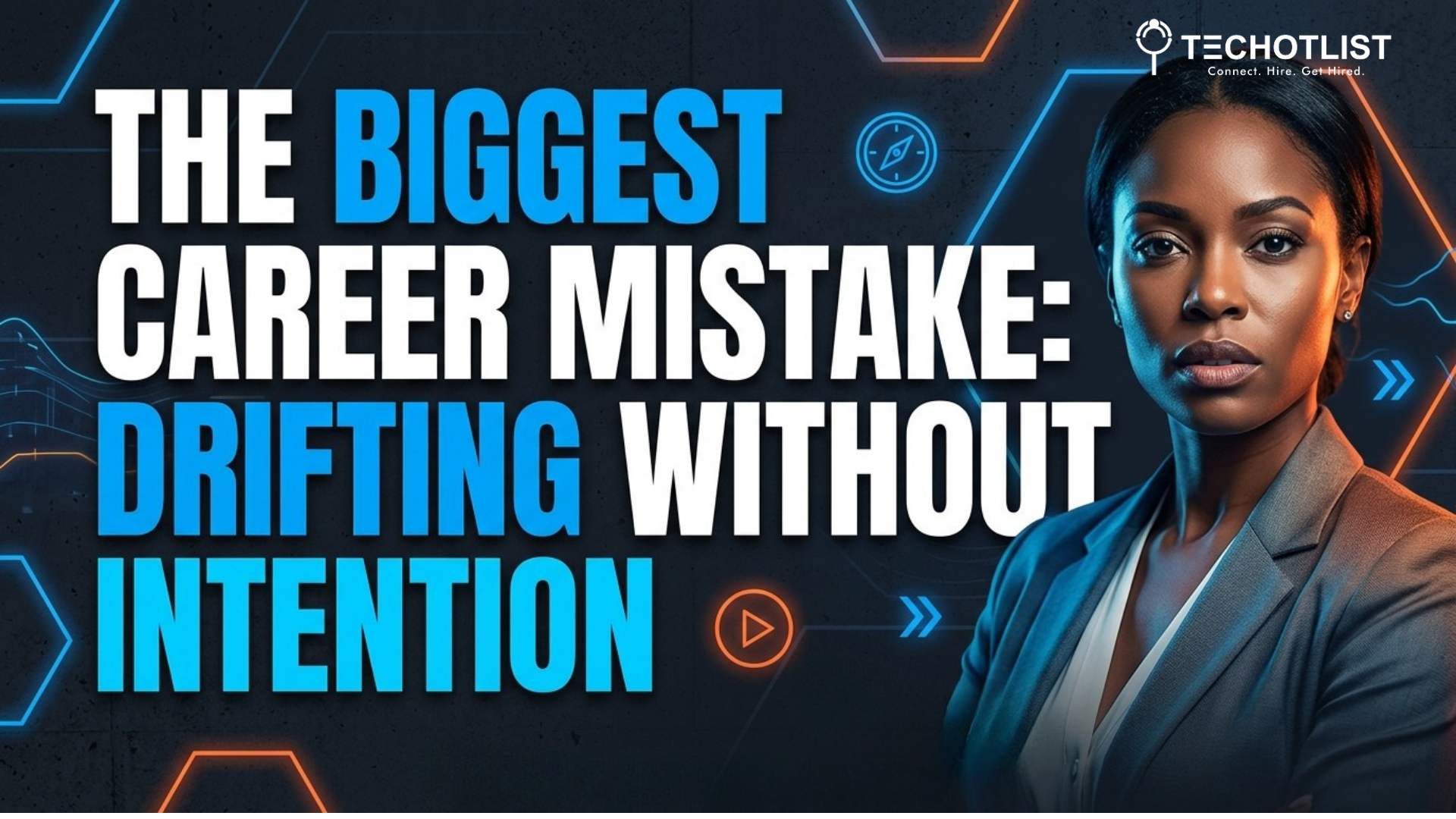
The Biggest Career Mistake: Drifting Without Intention (Why Passive Careers Cost You 10 Years You’ll Never Get Back)
“How we spend our days is, of course, how we spend our lives.”, Annie Dillard
A 32-year-old scrolls through their own resume and pauses.
7 companies. 4 industries. Dozens of titles. A salary that doubled. A decade of effort.
And still the quiet question: “But where am I actually going?”
This isn’t failure. Failure at least teaches. This is drift. And drift is sneakier than failure, because it looks like progress the whole way down.
The biggest career mistake isn’t picking the wrong company, the wrong role, or the wrong
boss.
It’s picking nothing, and letting the current decide for you.
What does “drifting” in a career actually mean?
Drifting is saying yes to every opportunity without ever asking:
“Does this get me closer to where I want to be in 3 to 5 years?”
It’s taking the promotion because it was offered. Staying in the job because it was easier.
Joining the company because your friend did. Learning the tool because it was trending.
Accepting the scope because the calendar was empty.
None of these are wrong. But together, without a compass, they become a career nobody
actually chose.
What this really means is simple:
Focused careers compound. Drifting careers scatter.
Why do so many smart people drift?
Because drifting feels safe.
You’re moving. You’re busy. You’re getting hikes. No one is calling you a failure. LinkedIn
celebrates you.
But safety and intention are not the same thing.
Stephen Covey writes in The 7 Habits of Highly Effective People: “Begin with the end in
mind.”
Most professionals never do. They begin with whatever Monday hands them. And 10 years
of whatever-Monday-hands-you is how a decade quietly disappears.
1. What do you actually end up with after a decade of drifting?
A collection. Not a career.
A resume full of random skills that don’t add up
A job history that reads like a menu, not a story
A LinkedIn headline that took 45 minutes to write, because nothing feels definitive
A body of work that can’t answer the question: “What do you do?”
Seneca said it 2,000 years ago: “If a man knows not to which port he is steering, no wind is
favorable.”
Every wind has been blowing for 10 years. You just never decided which port.
2. Why do your achievements stop feeling like achievements?
Because wins without a vision feel like loose change.
You got promoted, but to what bigger arc? You landed a great offer, but toward what
destination? You added a new skill, but for whom, for what?
When wins don’t connect to a North Star, they stop lighting up. The brain gets bored.
Dopamine fades. You chase the next promotion the way smokers chase the next cigarette, needing more, feeling less.
Viktor Frankl wrote: “Those who have a why to live can bear with almost any how.”
No “why” = no joy, even in the wins.
3. Does drifting really cost you that much?
Yes, but quietly. That’s what makes it dangerous.
Drift costs look like:
Mismatched resume, can’t position for the role you actually want at 35
Shallow expertise, you’re “good at many things, great at nothing”
Invisible ceiling, salary plateaus, market stops bidding for you
Identity confusion, you don’t know who you are professionally, so every bad day feels
existential
Regret compound interest, small “whatevers” at 28 become loud “what ifs” at 38
Brian Tracy put it sharply: “Those who don’t have clear goals are doomed forever to work
for those who do.”
4. How is an intentional career actually different?
An intentional career is built, not found.
It has:
- A North Star, one clear sentence on who you want to be in 3 to 5 years
- A roadmap, the skills, experiences, and people you need to get there
- Quarterly checkpoints, honest self-reviews, every 90 days
- Deliberate bets, you say YES to 1 thing and NO to 10 others
- A personal thesis, what you believe, what you stand for, what you’re building
Peter Drucker, the father of modern management, said: “The best way to predict the future
is to create it.”
Drifters wait for the future. Designers build it.
5. Isn’t it too late if I’ve already drifted for years?
No. And this is the most important sentence in this article.
The moment you decide to become intentional is the moment your career starts again, at any age, in any role, from any salary.
The only thing drift takes from you is time you didn’t notice passing. The moment you notice, you’re already out of it.
As Eckhart Tolle writes in The Power of Now: “Awareness is the greatest agent for change.”
Reading this article is already Step 1.
How do you stop drifting and start designing?
Treat your career like a product. Products have vision, roadmaps, and quarterly reviews. So
should you.
Step 1: Write your 3-year North Star. One clear sentence. Example: “In 3 years, I want to
be the go-to product leader for AI-native B2B platforms, leading a team of 10, with a public
track record.” Vague wishes don’t compound. Sentences do.
Step 2: Reverse-engineer the roadmap. Ask: What skills, what roles, what people, what
proof do I need to have by then? Write it down. Make it real.
Step 3: Run a 90-day review, honestly. Every quarter ask 3 questions:
What did I do this quarter that moved me closer?
What did I do this quarter that was just noise?
What’s the ONE thing I’ll commit to next quarter?
Step 4: Learn to say no, beautifully. Every yes you give to the wrong thing is a no to your real thing. Protect your plan like a founder protects equity.
Step 5: Build in public. Share what you’re learning. Write short posts. Ship a portfolio. Show your work. In 2026, visibility is part of the strategy, not an afterthought.
Annie Dillard’s line bears repeating: “How we spend our days is, of course, how we spend
our lives.”
How you spend your quarters is how you spend your decade. Choose accordingly.
The bottom line
The biggest career mistake isn’t picking the wrong role.
It’s not picking at all, and letting 10 years vote for you.
Drifting feels safe because nothing is breaking. But the danger of drift isn’t damage. It’s dilution. You get watered down, one indifferent year at a time, until you can’t remember
who you wanted to become.
The good news: intentionality doesn’t require a reset. It requires a decision.
One sentence. One roadmap. One 90-day bet. That’s where every great career, and every great life, quietly begins.
Ralph Waldo Emerson said it best: “Do not go where the path may lead; go instead where there is no path and leave a trail.”
Drift leaves no trail. Intention does.
Follow Taruna Vardha and Techotlist for career-decoded content that separates signal from noise, built for job seekers, recruiters, and professionals navigating 2026.
Techotlist, The Amazon for U.S. tech staffing. Hot jobs. Hot profiles. Clarity at speed.
Frequently Asked Questions
Q: How do I know if I’m drifting in my career?
Ask yourself one question: “If you paused my career today, could I write a 1-sentence thesis on where I’m going?” If you have to think for more than 30 seconds, you’re drifting.
Q: Q: Is drifting the same as being flexible or open-minded?
No. Flexibility is adapting your path. Drifting is not having a path. Open-minded professionals say yes selectively. Drifters say yes automatically.
Q: How do I find my career North Star?
Look for the Venn diagram of three things: what you’re good at, what you care about, and what the world will pay for. Your North Star lives in that overlap. Don’t overthink it, start rough and refine quarterly.
Q: What if I’m 35 and feel like I’ve already drifted too much?
Most of the most interesting careers are built after 35. The first half was data collection. The second half is design. You now have rare self-knowledge drifters don’t, use it as your edge, not your excuse.
Q: How often should I revisit my career intention?
Monthly reflection. Quarterly review. Annual redesign. Your North Star shouldn’t change often. Your path to it will.
Q: Can you be intentional in your career and still enjoy life?
Absolutely. In fact, intentional professionals enjoy life more, because their weekends aren’t polluted by the anxiety of a life they never chose.
Related posts
“How to Know If It’s Time to Switch Roles (5 Honest Signs, Before You Impulsively Quit)”
23 Apr 2026
Why Most People Feel Stuck in Their Careers (It’s Not the Job, It’s These 5 Hidden Traps)
23 Apr 2026
US Work Visa Layoffs: Rights, Grace Period & What to Do After Job Loss
16 Apr 2026
Why High-Paying Tech Jobs Feel Meaningless in 2026
17 Apr 2026