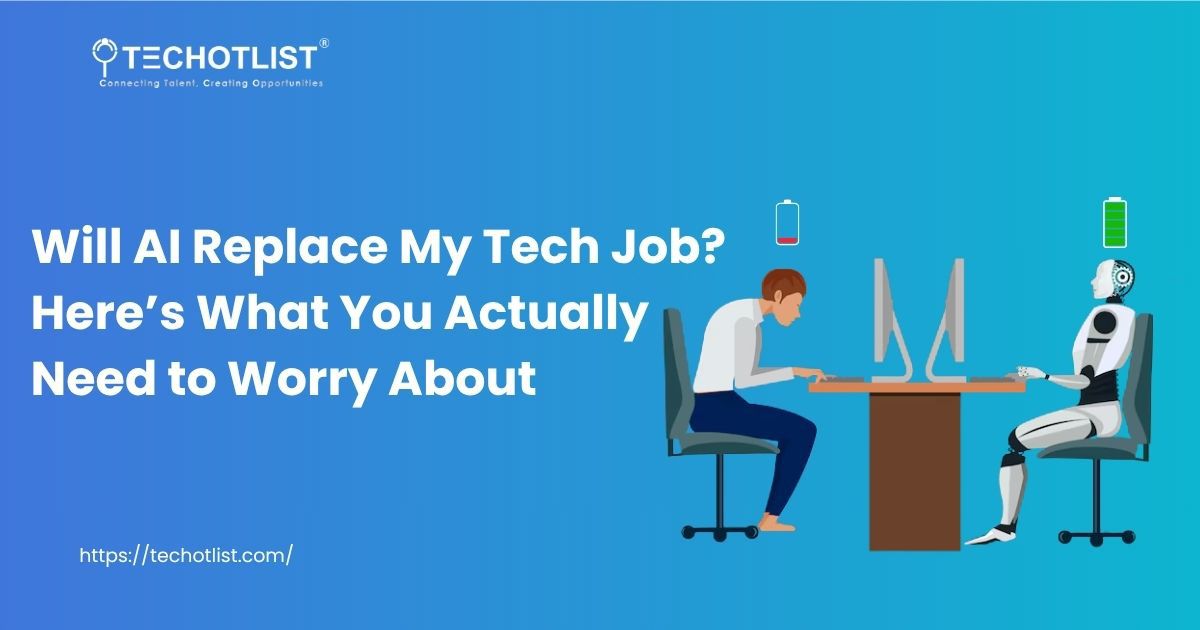
Will AI Replace My Tech Job in 2026? The Real Answer (No Hype)
If you work in tech in 2026, you’ve probably asked yourself this question:
Will AI replace my job?
With tools now writing code, generating designs, and automating workflows, the fear feels real.
But here’s the truth most people miss:
AI is not replacing entire tech jobs, it’s replacing specific tasks within them.
The real risk is not losing your job overnight, but becoming irrelevant if your skills don’t evolve.
Will AI replace tech jobs in 2026?
AI is not replacing entire tech jobs in 2026, but it is automating repetitive tasks within them. This means some roles may shrink or evolve, while new roles focused on AI, strategy, and problem-solving are growing rapidly.
The Reality: AI Replaces Tasks, Not Jobs
Most tech jobs are made up of multiple tasks.
AI is now automating:
- Repetitive coding
- Basic data analysis
- Documentation and content generation
But it cannot fully replace:
- Decision-making
- Product thinking
- System design
- Business understanding
This is why jobs are changing, not disappearing.
The AI Revolution in Tech: What’s Changing?
AI has undeniably transformed industries, especially in tech. From automating routine tasks to assisting with complex decision-making, AI tools are already reshaping the way we work. Technologies like machine learning, natural language processing, and robotic process automation are becoming commonplace, and some jobs in tech, like certain coding tasks or data analysis roles, could be automated.
But does that mean AI will replace your job completely? Not necessarily.
While AI is certainly capable of handling repetitive tasks, it’s still far from mastering the nuances of human creativity, problem-solving, and emotional intelligence. Here's a closer look at what AI can, and can’t, do in the tech industry.
What AI Can Do
- Automate repetitive tasks: AI is excellent at automating simple tasks like bug testing, data entry, and even certain aspects of software development (e.g., generating boilerplate code).
- Enhance decision-making: AI-powered tools can sift through vast amounts of data quickly, providing insights and predictions that assist with decision-making in fields like analytics, marketing, and product development.
- Improve efficiency: AI systems can work 24/7 without needing rest, leading to improved operational efficiency in many business areas.
What AI Can’t Do (Yet)
- Creative thinking and innovation: While AI can optimize existing processes, it cannot innovate, create new concepts, or think critically about abstract problems.
- Emotional intelligence and leadership: AI cannot replicate the human ability to understand complex social dynamics, offer mentorship, or demonstrate leadership.
- Complex problem-solving in unpredictable environments: AI thrives in controlled, structured scenarios but struggles in environments that require flexibility and adaptive problem-solving.
AI and Tech Jobs: The Impact
Jobs Most Likely to be Affected by AI
Some tech jobs may be more susceptible to AI disruption, particularly those that involve repetitive or rule-based tasks. These roles include:
- Data Entry Clerks: AI can quickly process and organize vast amounts of data without human intervention.
- Technical Support: AI-driven chatbots and virtual assistants can handle many customer queries, reducing the need for human support staff in some cases.
- Junior Software Developers: AI can automate aspects of coding, such as writing boilerplate code or performing code refactoring.
- QA Testers: Automated testing tools powered by AI can run through test scenarios faster and more accurately than manual testing.
Jobs Less Likely to Be Affected
On the other hand, there are tech roles that AI is less likely to replace, especially those that require creativity, critical thinking, and emotional intelligence. These include:
- AI and Machine Learning Engineers: As developers of AI systems, these professionals will continue to be in demand as AI continues to evolve.
- Cybersecurity Experts: AI may assist in detecting cyber threats, but human experts are still needed for nuanced security strategies and responses.
- Product Managers: While AI can assist with data-driven insights, human input is critical for aligning technology with customer needs and business goals.
- UX/UI Designers: Creating intuitive, user-friendly designs requires empathy and human-centered thinking, which AI can't replicate.
How to Future-Proof Your Tech Career
Instead of fearing AI, the key to surviving (and thriving) in the tech world is adaptation. Here are actionable steps to ensure your job remains relevant, even as automation and AI transform the industry.
Transferable Tech Skills You Need Before Your Niche Job Fades Away
1. Embrace Lifelong Learning
AI and technology are constantly evolving, and staying current is crucial. Invest in continuous learning to stay ahead:
- Learn AI and machine learning: Whether you're a developer, a product manager, or a designer, understanding AI and machine learning principles will make you more valuable.
- Expand into hybrid roles: Combine your technical expertise with soft skills like leadership, communication, and emotional intelligence.
- Upskill in related fields: Cloud computing, data science, and DevOps are fast-growing fields where tech professionals are in high demand.
2. Focus on Problem-Solving and Creativity
AI excels at automating routine tasks, but it can’t match human ingenuity and creativity. Emphasize roles that involve:
- Critical thinking: AI tools may analyze data, but they can’t devise strategies or solve complex, novel problems.
- Collaboration and leadership: Roles requiring team leadership, project management, and cross-functional collaboration are less likely to be automated.
3. Get Comfortable with AI Tools
Rather than avoiding AI, integrate AI tools into your workflow. For example:
- Automate repetitive tasks: Use AI for tasks like data cleaning, bug testing, and performance monitoring, freeing you up to focus on more valuable work.
- Leverage AI for decision support: Use AI tools for data analysis, making better decisions based on AI-driven insights.
4. Stay Agile and Adaptable
Being adaptable is a key asset in the age of AI. The more flexible you are in taking on new roles or learning new technologies, the more you'll secure your place in the workforce. Stay open to change and explore new job opportunities that emerge as AI continues to develop.
Case Study: Emily, a Software Developer
Emily, a software developer with five years of experience, initially feared that AI-driven tools might replace her job. However, instead of fearing this change, she embraced AI tools to streamline her coding workflow.
She started using code auto-completion tools and automated testing frameworks powered by AI, which significantly increased her productivity. As AI-assisted tools took over repetitive tasks, Emily had more time to focus on creative problem-solving, collaborating with cross-functional teams, and enhancing user experience design, skills AI cannot replicate.
Today, Emily is not only more efficient but has also expanded her role to include leading AI-powered projects within her organization.
FAQ: Common Questions About AI and Tech Jobs
1. Will AI take over my tech job entirely?
AI will likely automate some tasks, but it’s unlikely to replace tech jobs entirely. The key is to adapt by learning new skills and focusing on the aspects of your job that require creativity, critical thinking, and emotional intelligence.
2. Should I learn AI to future-proof my career?
Absolutely. Gaining knowledge of AI and machine learning will help you stay ahead of the curve, and understanding how these technologies work will make you an asset in roles that integrate AI.
3. Which tech jobs are most at risk of being automated?
Roles that involve repetitive, rule-based tasks, like data entry, junior software development, and technical support, are most at risk of automation. However, even these jobs will require human oversight and creative thinking.
Conclusion:
AI is undeniably transforming the tech industry, but rather than fearing it, embrace it as an opportunity. By focusing on creativity, problem-solving, and continual learning, you can ensure that your tech career remains secure. AI will likely handle routine tasks, but human professionals will continue to drive innovation, lead teams, and solve complex challenges. So, rather than worrying about AI replacing your job, focus on the skills that will make you indispensable in the AI-driven future of work.
Related posts

Stop Hiding Your $150K Skill, How Prompt Engineering Can Boost Your Salary by $18K+
31 Dec 2025
AI Skills Fortune 500 Companies Are Hiring for in 2026
10 Apr 2026
AI in Software Testing: How to Catch 90% of Bugs Before Release
31 Dec 2025
High Paying AI Jobs in 2026: Why Product Managers Are Leading the Shift
01 Apr 2026
Why This AI Question Will Dominate 2025 Job Interviews (And How to Answer It)
12 Aug 2025