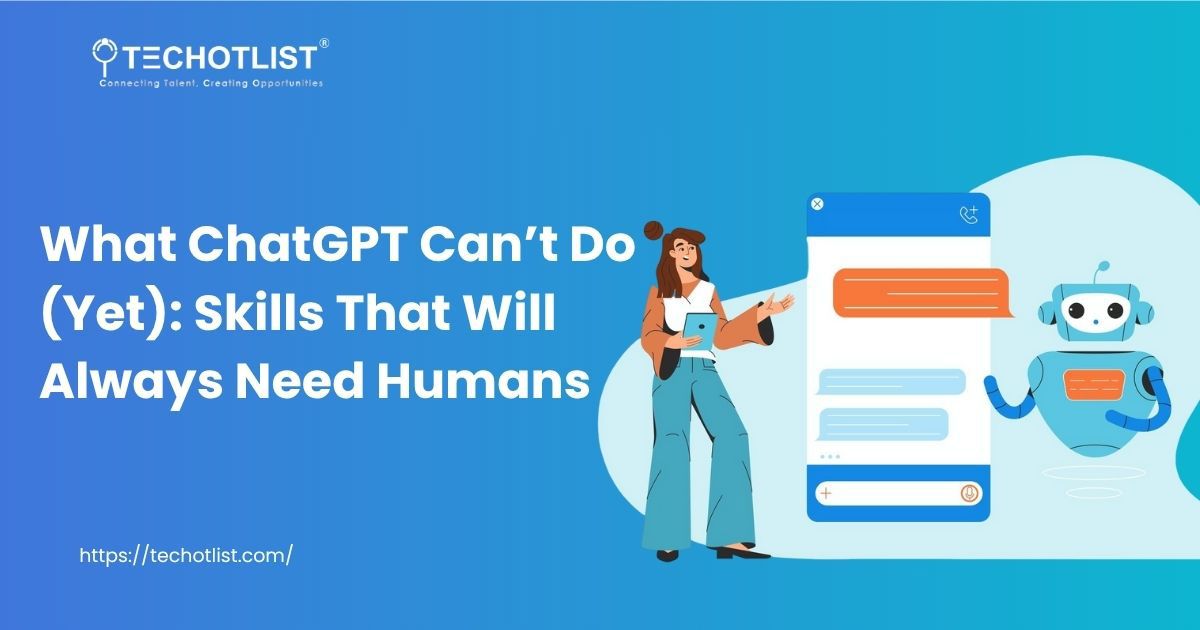
What ChatGPT Can’t Do (Yet): Skills That Will Always Need Humans
In recent years, advancements in Artificial Intelligence (AI), particularly in language models like ChatGPT, have been making headlines across industries. From automating customer support to generating content, AI is transforming the way we work. However, despite its growing capabilities, there are areas where AI, including ChatGPT, still falls short. The question arises: What tasks and skills will always need a human touch? In this article, we'll explore the human skills that AI can't replicate, emphasizing the importance of human involvement in a rapidly changing tech landscape.
Introduction: Why Human Skills Matter More Than Ever
As AI continues to revolutionize industries, many fear that their jobs might become obsolete. While it's true that AI is replacing some routine tasks, the skills that make us uniquely human, empathy, creativity, and critical thinking, are irreplaceable. These skills ensure that humans remain vital in the workforce, especially in roles requiring complex decision-making, emotional intelligence, and ethical judgment. This article will delve into the areas where humans still hold a distinct advantage and why these skills are essential for the future.
1. Creative Problem-Solving and Innovation
AI systems, including ChatGPT, excel at processing large datasets, identifying patterns, and automating routine tasks. However, when it comes to innovation, thinking outside the box to create something new or solve complex problems, humans are irreplaceable.
Why It Matters:
Complex decision-making: AI follows pre-established algorithms and cannot think outside of programmed parameters.
Creative insights: While AI can generate content or suggest solutions, it lacks the true creativity that humans possess, especially in artistic and innovative domains.
Example:
Think about product development in tech. AI can help identify user preferences through data, but it’s the human designer who will craft a truly unique user experience that feels intuitive and resonates emotionally with the user.
2. Emotional Intelligence and Empathy
One of the core aspects of human intelligence is our ability to understand and manage emotions, both our own and others'. ChatGPT and other AI models can simulate conversations, but they cannot truly understand emotions or offer genuine empathy.
Why It Matters:
Building relationships: AI cannot establish trust or form real relationships. Human connections, especially in customer service or therapy, are built on empathy and understanding.
Conflict resolution: In workplaces, conflicts often require human sensitivity to navigate emotional nuances, which AI cannot manage.
Example:
Consider a customer service agent handling a distressed customer. While AI can provide responses, it takes a human agent to calm the situation, empathize, and find a resolution that feels personalized.
3. Ethical Judgment and Decision-Making
As AI systems become more integrated into society, ethical considerations become more important. ChatGPT and similar models cannot make ethical judgments, they follow logic but lack moral understanding.
Why It Matters:
Complex ethical decisions: Humans must make decisions that involve ethical considerations, particularly in industries like healthcare, law, and tech.
Bias mitigation: AI is only as unbiased as the data it’s trained on, and it can perpetuate existing biases if not carefully monitored.
Example:
In healthcare, an AI might suggest a treatment plan based on data, but it’s the human doctor who considers the patient's history, values, and ethical implications before making the final decision.
4. Strategic Leadership and Vision
AI can analyze data and predict trends, but it cannot create a strategic vision or lead an organization with the foresight and flexibility that a human leader brings. Strategic thinking requires not just understanding current trends but anticipating future challenges and opportunities.
Why It Matters:
Adaptability: AI operates within the limits of its programming and cannot anticipate unpredictable events or changes in the business environment.
Vision: Leaders must inspire teams, set goals, and navigate challenges—tasks that require a deep understanding of human motivations and societal shifts.
Example:
In business, a CEO uses both data and intuition to set the company's direction, adjusting the strategy based on market conditions, competition, and unforeseen events, something AI cannot replicate.
5. Communication and Collaboration
While AI can assist in communication by drafting emails or generating reports, it cannot replace the nuanced communication that happens between humans. The ability to collaborate, negotiate, and engage in meaningful conversations is deeply human.
Why It Matters:
Interpersonal skills: Communication is more than just words—it's about tone, body language, and context. AI lacks the ability to understand these nuances fully.
Team dynamics: Collaboration in teams involves understanding diverse perspectives, emotional cues, and group dynamics—skills that AI cannot emulate.
Example:
In project management, a human leader can mediate discussions between team members with differing opinions, finding common ground and fostering collaboration, while AI can only offer suggestions based on data without understanding the interpersonal dynamics at play.
6. Hands-On Technical Skills and Craftsmanship
While AI has made strides in automating many technical tasks, there are still many hands-on, highly skilled jobs that require human expertise. Fields like construction, engineering, and manufacturing require technical skills that AI cannot replace.
Why It Matters:
Precision and judgment: Humans can make real-time adjustments based on tactile feedback and their experience, something AI cannot replicate.
Manual dexterity: Certain tasks, especially in art, craftsmanship, or engineering, require physical skills that AI simply cannot perform.
Example:
A skilled carpenter or a surgeon makes decisions during their work that go beyond technical knowledge, they rely on their intuition, years of practice, and situational awareness to complete tasks that AI tools cannot handle.
Conclusion: Embracing Human Strengths in the Age of AI
AI, including ChatGPT, is here to stay, and its role in the workforce will continue to expand. However, it’s crucial to recognize the limitations of AI and understand where human skills are irreplaceable. While AI can augment many tasks, the need for creativity, emotional intelligence, ethical decision-making, leadership, communication, and hands-on skills will always require a human touch.
As we move forward, professionals should focus on developing these inherently human skills that cannot be replicated by AI. Embracing and nurturing these strengths will not only ensure job security but will also enable us to thrive alongside AI in a symbiotic future. By focusing on what makes us uniquely human, we can remain indispensable in the workforce, ensuring that technology works for us, not the other way around.
FAQ:
Can AI replace all human jobs?
No, AI can automate many tasks, but there are skills, like creativity, emotional intelligence, and ethical judgment, that AI cannot replicate.
How can I future-proof my career against AI?
Focus on developing creativity, leadership, emotional intelligence, and technical craftsmanship,skills that AI cannot replicate.
Related posts
Stop Hiding Your $150K Skill, How Prompt Engineering Can Boost Your Salary by $18K+
31 Dec 2025
AI Skills Fortune 500 Companies Are Hiring for in 2026
10 Apr 2026
AI in Software Testing: How to Catch 90% of Bugs Before Release
31 Dec 2025
High Paying AI Jobs in 2026: Why Product Managers Are Leading the Shift
01 Apr 2026
Why This AI Question Will Dominate 2025 Job Interviews (And How to Answer It)
12 Aug 2025