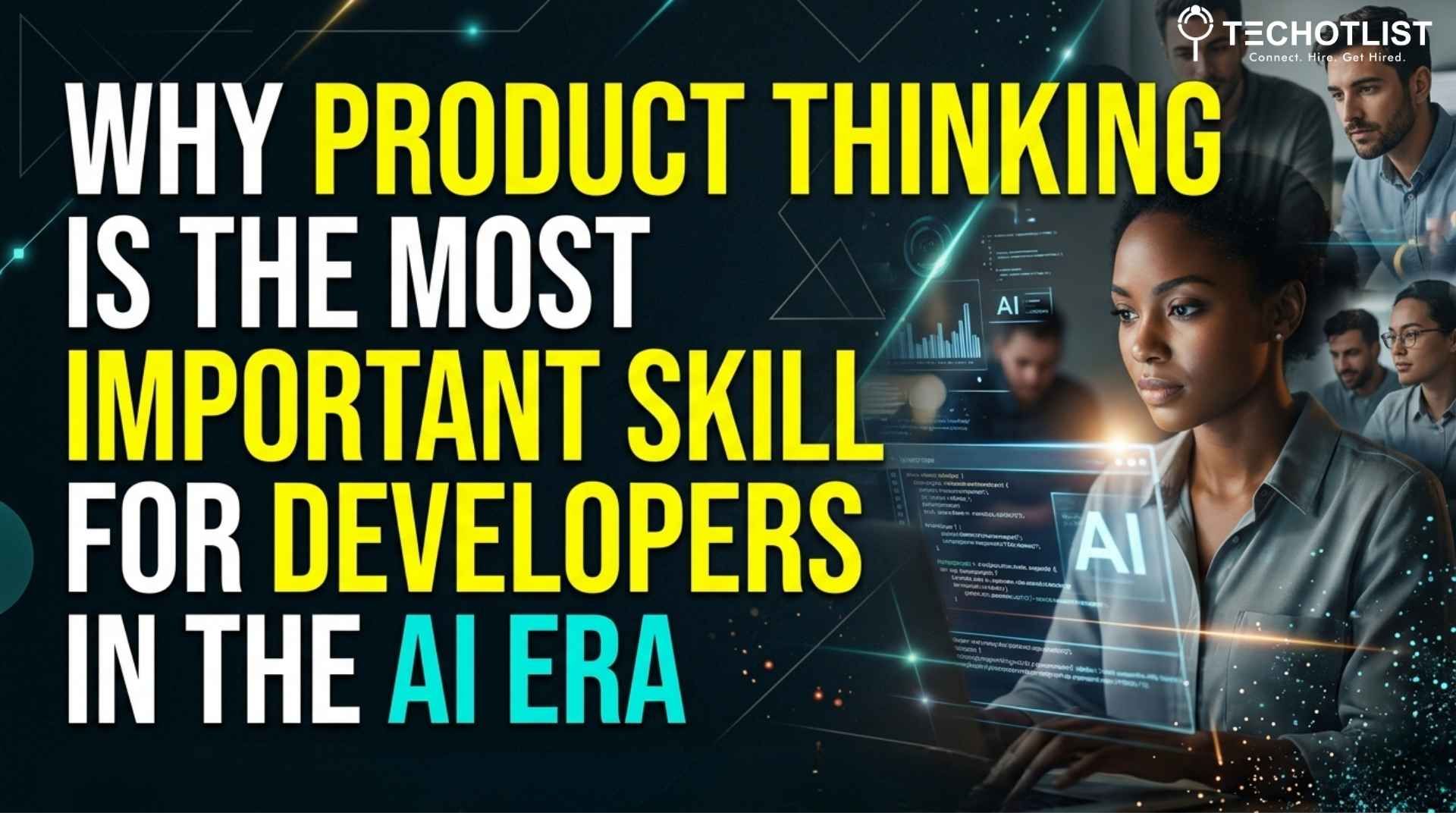
Why Product Thinking Is the Most Important Skill for Developers in the AI Era
In 2026, writing code is no longer the hardest part of building software.
AI tools can generate code, design interfaces, and even deploy products faster than ever. But this shift has created a new bottleneck: knowing what to build and why.
This is why coders are rapidly evolving into product thinkers.
Developers who understand users, business impact, and product strategy are becoming far more valuable than those who only write code. In this article, we break down why this shift is happening and how you can stay ahead.
What does it mean for coders to become product thinkers?
Coders becoming product thinkers means developers are moving beyond writing code to understanding user needs, business goals, and product impact. In 2026, this shift is critical as AI automates coding, making decision-making and problem selection more valuable than implementation.
What Is Product Thinking?
Product thinking is the mindset of approaching software development with a deep understanding of user needs, business objectives, and long-term value. It goes beyond writing code, it’s about delivering impact.
A coder who embraces product thinking asks:
Who is the user?
What problem are we solving?
Is this the simplest and most effective solution?
How will this scale or evolve?
This mindset bridges the traditional gap between engineering and product management, creating a hybrid professional who codes with purpose.
Why Product Thinking Is the Future of Software Development
1. AI Is Automating Routine Coding
Tools like GitHub Copilot and ChatGPT are changing the landscape. Junior-level tasks like writing CRUD operations or validating forms can be auto-generated. What can’t be replaced easily? Human intuition, empathy, and product insight.
2. Companies Want Outcome-Driven Engineers
Startups and scale-ups alike want engineers who:
Prioritize user experience
Can challenge ambiguous product specs
Understand trade-offs between effort, impact, and scalability
This shift in demand rewards developers who think beyond the ticket or Jira task.
3. Faster Career Growth and Influence
Coders who think like product managers often:
Get promoted faster
Gain a seat at strategic discussions
Influence roadmaps and business priorities
They become not just executors, but collaborators in building what truly matters.
A Real-World Example: From Engineer to Product Owner
Case Study: Anusha, Full-Stack Developer at a Fintech Startup
When Anusha joined as a developer, she was expected to code features defined by the product team. But she consistently asked why those features were needed and suggested alternatives based on customer feedback she’d seen in support tickets.
Eventually, the CEO invited her to shadow product meetings. Within a year, she was promoted to Technical Product Owner, leading a small squad to define and implement new lending features. Her unique edge? She could speak the language of both code and customers.
Also Read: Will AI Replace My Tech Job? Here’s What You Need to Worry About
Signs You’re Already Thinking Like a Product Person
You ask questions about users, not just requirements
You proactively suggest improvements to UX or functionality
You track usage data or metrics post-release
You care about customer support tickets, even if it’s not “your job”
You push back when a feature doesn’t solve the right problem
If these describe you, you’re on the right path.
How to Develop Product Thinking as a Developer
Here’s how any developer, junior or senior, can start building product muscle:
1. Spend Time With Users
Sit in on customer calls or feedback sessions
Read support tickets and user reviews
2. Understand the Business Model
Know how your company makes money
Ask how a feature aligns with company OKRs (Objectives and Key Results)
3. Learn to Define Problems, Not Just Solve Them
Practice writing problem statements
Ask “Is this a solution in search of a problem?”
4. Work With Product Managers (PMs) Closely
Offer to pair on feature scoping
Ask how product priorities are set
5. Embrace MVP Thinking
Prioritize shipping value quickly over perfection
Look for quick feedback loops
Product Thinking vs Traditional Coding Focus
Frequently Asked Questions (FAQ)
Why are coders becoming product thinkers?
Because AI is automating coding tasks, making problem-solving and decision-making more valuable than writing code.
What is product thinking in software development?
Product thinking is the ability to understand user needs, business goals, and build solutions that deliver real value
Is coding still important in 2026?
Yes, but it’s no longer enough on its own. Developers need product and strategic thinking skills to stay relevant.
How can developers learn product thinking?
By engaging with users, understanding business goals, and participating in product decisions, not just coding tasks.
Will AI replace developers?
AI will not replace developers but will change their role, making product thinking and decision-making more important.
Conclusion: Don’t Just Ship Code, Ship Outcomes
In today’s AI-assisted world, your ability to think is more valuable than your ability to type. Developers who embrace product thinking are the ones who rise fastest, influence strategy, and make the deepest impact. The next time you receive a feature spec or Jira ticket, pause and ask:
What problem is this solving, and is this the best way to solve it?
That’s the moment you shift from coder to creator.
Related posts

Stop Hiding Your $150K Skill, How Prompt Engineering Can Boost Your Salary by $18K+
31 Dec 2025

AI Skills Fortune 500 Companies Are Hiring for in 2026
10 Apr 2026

AI in Software Testing: How to Catch 90% of Bugs Before Release
31 Dec 2025
High Paying AI Jobs in 2026: Why Product Managers Are Leading the Shift
01 Apr 2026
Why This AI Question Will Dominate 2025 Job Interviews (And How to Answer It)
12 Aug 2025