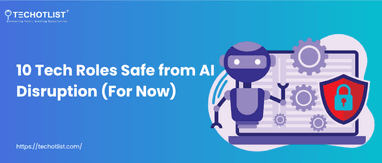
10 Tech Roles Safe from AI Disruption (For Now)
Artificial Intelligence (AI) is transforming industries at a rapid pace, often sparking concern among professionals about the future of their careers. As automation continues to improve, many wonder: Which tech jobs are at risk of being replaced by AI? The truth is, while some roles may face disruption, others remain relatively safe, at least for now.
In this article, we’ll explore 10 tech roles that are safe from AI disruption, providing you with practical insights into why these careers continue to thrive in an AI-driven world. By the end of this read, you'll have a better understanding of which roles to pursue and how to future-proof your career.
1. AI/Machine Learning (ML) Engineers
Why Safe?
AI and Machine Learning are among the most powerful technological advancements of our time, yet they still require human oversight for design, development, and optimization. As AI continues to evolve, so does the demand for engineers who can train, refine, and fine-tune these systems.
Real-World Example:
Companies like Google, Facebook, and Microsoft are constantly enhancing their AI systems, but their engineers remain crucial in pushing the boundaries of what AI can achieve. As AI gets more complex, more engineers are needed to build and maintain these systems.
2. Cybersecurity Specialists
Why Safe?
While AI is being used to detect anomalies and threats, human expertise is still required for strategic decision-making, understanding complex cyberattacks, and responding in real-time. Cybersecurity experts are needed to create secure systems and respond to threats that AI cannot predict.
Practical Scenario:
In 2020, a hacker group used AI tools to target critical infrastructure systems. However, it was the cybersecurity professionals who stopped the attack by analyzing patterns and reacting to threats, demonstrating that human intuition and decision-making remain irreplaceable.
3. Data Scientists
Why Safe?
AI and machine learning are heavily reliant on data scientists to build models, perform complex analyses, and extract actionable insights. These roles demand creativity and domain expertise, which are difficult for AI to replicate. As long as there is data, data scientists will continue to be essential.
Actionable Insight:
AI can process data, but it needs human scientists to interpret results, apply them to the right contexts, and communicate insights in ways that drive decisions. As data continues to grow, so does the need for skilled professionals.
4. Cloud Architects
Why Safe?
With the expansion of cloud computing, companies need cloud architects to design, build, and manage complex cloud infrastructures. While AI may assist in optimizing processes, cloud architecture requires deep technical knowledge and strategic foresight that machines cannot replace.
Case Study:
Companies like Amazon Web Services (AWS) and Google Cloud offer cloud solutions, but it’s the human experts who determine the best architecture, troubleshoot issues, and design systems tailored to business needs. These decisions often involve multiple variables that AI cannot yet fully comprehend.
5. Ethical Hackers
Why Safe?
Ethical hackers, or penetration testers, use their understanding of cybersecurity to help organizations identify vulnerabilities before malicious hackers do. As AI-based security tools evolve, ethical hackers are necessary to think like real-world attackers and anticipate new attack vectors that AI might miss.
Real-World Scenario:
In recent years, ethical hackers have been employed to test AI-powered security systems, revealing potential flaws and vulnerabilities that could have been exploited otherwise. This shows the need for human intuition to anticipate new threats in an ever-changing landscape.
6. Product Managers
Why Safe?
Product managers are responsible for leading product development, understanding user needs, and overseeing a product’s lifecycle from ideation to launch. While AI can assist with market analysis or product design feedback, human managers are essential for making strategic decisions and navigating the complexities of cross-functional teams.
Illustrative Example:
In tech companies like Apple or Tesla, product managers play an integral role in aligning business goals with customer needs. Their ability to synthesize feedback, mediate between engineering and marketing teams, and anticipate user behavior makes their role irreplaceable, especially in dynamic, competitive markets where agility and empathy are key differentiators.
7. UX/UI Designers
Why Safe?
User Experience (UX) and User Interface (UI) design require deep understanding of human behavior, psychology, and cultural contexts. While AI can generate layout suggestions or automate design tweaks, it lacks empathy, emotional insight, and the contextual awareness to create truly engaging user experiences.
Design in Action:
A ride-sharing app improved its customer retention by 27% after a UX team redesigned the onboarding flow based on human-centered feedback. AI tools had failed to identify friction points, highlighting the limits of purely data-driven design without human insight.
8. DevOps Engineers
Why Safe?
DevOps is all about integrating development and operations. It involves automating pipelines, monitoring infrastructure, and responding to failures. While AI tools can automate some tasks, judgment during outages, performance tuning, and incident management still require hands-on expertise.
Practical Example:
In a cloud outage scenario at a SaaS company, automated monitoring tools failed to detect the root cause. A DevOps engineer diagnosed a configuration drift issue and restored services manually. This highlights how automation alone is not enough, especially in high-stakes environments.
9. Systems Architects
Why Safe?
System architecture involves designing scalable, secure, and resilient systems by choosing the right technologies, ensuring compliance, and aligning with business goals. It requires strategic foresight, cross-domain understanding, and the ability to anticipate edge cases, areas where AI still lacks maturity.
Insight:
When building an enterprise platform, a systems architect may need to integrate legacy infrastructure, design multi-cloud strategies, and prepare for data privacy regulations. These nuanced decisions involve trade-offs and long-term thinking that are not yet programmable.
10. Technical Program Managers (TPMs)
Why Safe?
TPMs bridge the gap between strategy and execution. They manage cross-functional teams, balance competing priorities, and ensure delivery against shifting goals. AI may assist with scheduling or tracking, but it lacks the emotional intelligence and negotiation skills needed to resolve conflicts and drive collaboration.
Scenario:
At a major health tech firm, a TPM coordinated a high-stakes product rollout involving remote teams across four time zones. While AI scheduling helped with logistics, the TPM’s leadership ensured clarity, accountability, and delivery, skills that can’t be encoded.
Key Takeaways: What Makes These Roles AI-Resistant?
Here’s a quick look at the core human skills that protect these roles from AI disruption:
Frequently Asked Question's:
Q1: Will these roles stay safe forever?
Not indefinitely. AI is evolving quickly, but these roles are safer because they depend heavily on human creativity, judgment, and adaptability. Keep learning and adapting to stay ahead.
Q2: What should I do if my current role is being automated?
Identify overlap with the roles listed above and upskill. For instance, if you're in QA, transitioning into DevOps or cybersecurity can make your skillset more resilient.
Q3: Are soft skills really that important?
Absolutely. In a future where AI handles repetitive tasks, soft skills will be your superpower, especially those involving collaboration, empathy, and leadership.
Conclusion:
AI is transforming the tech landscape, but it's not wiping out all roles, especially not the ones that require complex problem-solving, emotional intelligence, creativity, or ethical reasoning. By aligning your career with these AI-resistant roles, you can not only safeguard your future but thrive in it.
Next Step:
Evaluate your current role. Identify which of these resilient skills you already possess, and which you can develop. Start learning, start evolving, because the safest tech job is the one that keeps growing.
Related posts
Stop Hiding Your $150K Skill, How Prompt Engineering Can Boost Your Salary by $18K+
31 Dec 2025
AI Skills Fortune 500 Companies Are Hiring for in 2026
10 Apr 2026
AI in Software Testing: How to Catch 90% of Bugs Before Release
31 Dec 2025
High Paying AI Jobs in 2026: Why Product Managers Are Leading the Shift
01 Apr 2026
Why This AI Question Will Dominate 2025 Job Interviews (And How to Answer It)
12 Aug 2025